
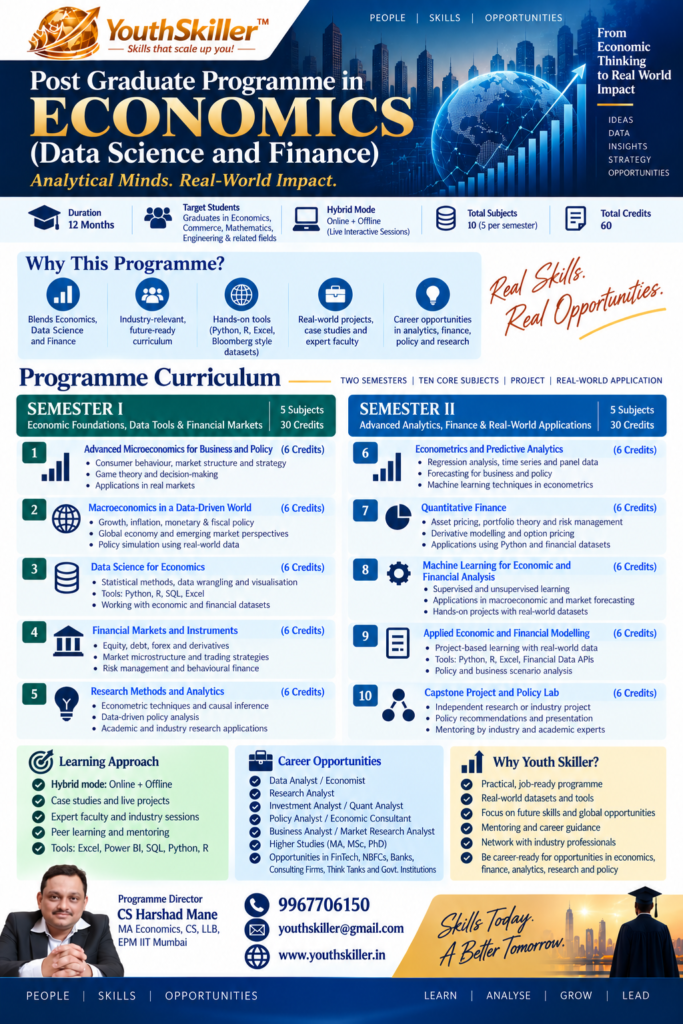
POST GRADUATE DIPLOMA IN
ECONOMICS
Applied Economics | Finance | Quantitative Analysis | Business Analytics | Economic Intelligence | Geoeconomics
| Programme | Post Graduate Diploma in Economics |
| Duration | 12 Months |
| Structure | 2 Semesters + 2 Integrated Capstone Projects |
| Subjects | 11 Subjects |
| Credits | 66 Subject Credits + 6 Capstone Credits = 72 Credits |
| Mode | Hybrid :Online + Offline (Live Interactive Sessions) |
| Target Group | Commerce & Economics Graduates; Finance, Business, Analytics and aspiring professionals |
1. Programme Vision
The YouthSkiller Post Graduate Diploma in Economics is designed as a rigorous, applied and professionally oriented programme. It is not intended to be a compressed version of a conventional M.A./M.Sc. Economics curriculum. Instead, it combines economic reasoning with finance, quantitative methods, business analytics, economic intelligence, game theory, econometrics, quantitative finance and geoeconomics, that is required for any student of Ecnomics, finance, business and commerce, to work in the demanding and dynamic financial international world.
2. Programme Objectives
- Develop rigorous foundations in microeconomics, macroeconomics, mathematical economics and statistical economics.
- Enable learners to interpret the Indian economy, financial system, markets and global economic environment.
- Build practical capability in econometrics, forecasting, business analytics and quantitative finance.
- Develop the ability to convert economic, business and market information into actionable Economic Intelligence.
- Apply game theory to competition, negotiation, market entry and strategic decision-making.
- Understand corporate finance, valuation and investment analysis in real-world contexts.
- Develop the ability to analyse countries, sectors and economic risks through a geoeconomic lens.
- Produce professional analytical outputs rather than purely academic dissertations.
- Integrate Excel, Python, Data presentation tools and AI-assisted analytical tools into economic and business analysis.
- Build the communication, presentation and consulting skills required for careers in analytics, finance, research, strategy and economic intelligence.
3. Learning Outcomes
- Analyse consumer, firm and market behaviour using microeconomic frameworks.
- Interpret GDP, inflation, employment, monetary policy, fiscal policy and business cycles.
- Use mathematical and statistical tools to formulate and test economic relationships.
- Conduct regression and time-series analysis and evaluate forecasting models.
- Build business dashboards and analytical models using real datasets.
- Evaluate companies using financial statement analysis, valuation and investment frameworks.
- Apply portfolio, risk and quantitative finance concepts using Excel and Python.
- Use game theory to analyse strategic interactions and competitive decisions.
- Construct Economic Intelligence briefs, sector reports, country outlooks and risk assessments.
- Assess geoeconomic developments and their implications for business, investment and national strategy.
- Complete evidence-based capstone projects that move from data and analysis to actionable recommendations.
4. Who Is This Programme For?
- Commerce and Economics graduates seeking a practical postgraduate qualification.
- Graduates entering finance, investment, analytics, consulting, research and business strategy.
- Working professionals who want stronger economics and quantitative decision-making capabilities.
- Entrepreneurs and startup professionals who need market, sector, financial and economic intelligence.
- Aspiring economic analysts, business analysts, financial analysts and research professionals.
- Professionals preparing for roles involving policy, markets, investment, consulting and economic intelligence.
5. Programme Architecture
| Semester | Academic Subjects | Capstone | Credits |
| Semester I | 5 subjects × 6 credits | 2 integrated projects | 30 + 3* |
| Semester II | 6 subjects × 6 credits | 2 integrated projects | 36 + 3* |
| Total | 11 subjects | 4 applied project outputs | 72 |
*Each semester’s capstone component carries 3 integrated credits. The two projects within each capstone component are assessed as a unified semester project portfolio.
6. Semester-wise Curriculum :At a Glance
| No. | Semester I :Economic Foundations, Finance & Intelligence | Credits |
| 1 | Applied Microeconomics | 6 |
| 2 | Applied Macroeconomics & Indian Economy (with AI for Economic Analysis) | 6 |
| 3 | Statistical & Mathematical Economics | 6 |
| 4 | Financial Economics, Markets & Banking | 6 |
| 5 | Economic Intelligence & Business Forecasting | 6 |
| Capstone I | Economic Outlook of India Business Analytics with Excel | 3 |
| No. | Semester II :Quantitative Economics, Finance & Strategic Analytics | Credits |
| 6 | Econometrics & Economic Forecasting | 6 |
| 7 | Business Analytics for Economists | 6 |
| 8 | Corporate Finance & Valuation | 6 |
| 9 | Quantitative Finance | 6 |
| 10 | Game Theory & Strategic Decision Making | 6 |
| 11 | Geoeconomics & the New International Economic Order | 6 |
| Capstone II | Financial AnalyticsCountry Outlook Report | 3 |
7. Detailed Curriculum
SEMESTER I
1. Applied Microeconomics for Business | 6 Credits
Purpose: Build the economic logic needed to understand consumers, firms, competition, pricing and market strategy.
Module 1 :Economic Reasoning
- Scarcity, opportunity cost, incentives and marginal analysis.
- Positive versus normative reasoning and the use of models in decision-making.
- Trade-offs, efficiency and economic surplus.
Module 2 :Demand, Consumers & Behaviour
- Preferences, utility and budget constraints.
- Demand curves, elasticity and income/substitution effects.
- Consumer surplus and practical demand analysis.
- Behavioural economics: bounded rationality, biases, nudges and real-world deviations from the standard model.
Module 3 : Production, Costs & Firm Decisions
- Production functions and productivity.
- Short-run and long-run costs.
- Profit maximisation, cost minimisation and economies of scale.
- Make-or-buy, capacity and operating decisions.
Module 4 :Market Structures & Pricing
- Perfect competition, monopoly and monopolistic competition.
- Oligopoly and strategic competition.
- Price discrimination, bundling and dynamic pricing.
- Market concentration and competitive strategy.
Module 5 :Market Failure & Regulation
- Externalities and public goods.
- Information asymmetry, adverse selection and moral hazard.
- Regulation, competition policy and welfare.
Module 6 :Business Cases
- Pricing strategy, market entry, competitor analysis and platform markets.
- Case-based economic analysis of real businesses.
2. Applied Macroeconomics & Indian Economy (with AI for Economic Analysis) | 6 Credits
Purpose: Develop the ability to interpret macroeconomic conditions and translate them into business and policy implications.
Module 1 :National Income & Economic Measurement
- GDP, GVA, nominal and real GDP, GDP deflator and national income accounting.
- Consumption, savings, investment and aggregate demand.
- Limits of GDP as a measure of welfare.
Module 2 :Growth, Cycles & Productivity
- Sources of long-run growth.
- Capital, labour, human capital and technology.
- Business cycles, leading indicators, recessions and recoveries.
- Productivity and structural transformation.
Module 3 :Inflation, Employment & Monetary Economics
- CPI, WPI, core inflation and inflation expectations.
- Unemployment, labour-force participation and wage dynamics.
- Money, banking, interest rates and monetary transmission.
- RBI framework and the Indian financial system.
Module 4 :Fiscal Policy & Public Finance
- Government expenditure, taxation and fiscal deficit.
- Public debt and fiscal sustainability.
- Fiscal multipliers and policy trade-offs.
- Reading and interpreting the Union Budget.
Module 5 :Indian Economy
- Indian economic structure: agriculture, manufacturing and services.
- Demographics, urbanisation, infrastructure and employment.
- Economic reforms, institutions and contemporary structural challenges.
- External sector, exchange rates and global economic linkages.
Module 6 :AI for Economic Analysis
- AI-assisted economic research and information synthesis.
- Prompting for economic analysis and policy questions.
- AI-assisted forecasting, scenario building and report drafting.
- Verification, source criticism, hallucination risk and responsible use of AI.
3. Statistical & Mathematical Economics | 6 Credits
Purpose: Build the quantitative foundation required for economics, econometrics, analytics and financial modelling.
Module 1 :Mathematical Foundations
- Functions, graphs, equations, simultaneous equations, exponents and logarithms.
- Sequences, rates of change and economic interpretation.
Module 2 :Calculus & Optimisation
- Differentiation and partial derivatives.
- Marginal concepts and elasticity.
- Unconstrained and constrained optimisation.
- Lagrangian methods and economic applications.
Module 3 :Linear Algebra & Economic Models
- Matrices, vectors and systems of equations.
- Input-output and equilibrium applications.
- Comparative statics and economic modelling.
Module 4 :Probability & Statistical Foundations
- Probability concepts, random variables and distributions.
- Expected value, variance and covariance.
- Sampling and sampling distributions.
Module 5 :Statistical Inference
- Estimation and confidence intervals.
- Hypothesis testing and p-values.
- Type I/II errors and statistical significance.
Module 6 :Relationships in Economic Data
- Correlation and simple regression.
- Multiple regression foundations.
- Interpretation of coefficients and model limitations.
- Applications to economic and business datasets.
4. Financial Economics, Markets & Banking | 6 Credits
Purpose: Connect economic theory with the operation of financial markets, banking and monetary transmission.
Module 1 :Financial Economics
- Time value of money.
- Risk and return.
- Expected return, uncertainty and capital allocation.
Module 2 :Financial Markets
- Equity, debt, money, foreign exchange and commodity markets.
- Market participants, instruments and price discovery.
- Primary and secondary markets.
Module 3 :Banking & Monetary System
- Commercial banking and credit creation.
- Central banking and the RBI.
- Monetary transmission and liquidity.
- Interest-rate and credit cycles.
Module 4 :Financial Institutions
- NBFCs and alternative credit.
- FinTech and digital finance.
- Financial inclusion and new financial business models.
Module 5 :Applied Financial Economics
- How macroeconomic changes affect financial markets.
- Case studies linking rates, inflation, liquidity and asset prices.
5. Economic Intelligence & Business Forecasting | 6 Credits
Purpose: Develop the signature capability of the programme: converting economic and market information into decision-useful intelligence.
Module 1 :Foundations of Economic Intelligence
- Data vs information vs intelligence.
- The intelligence cycle: question, collection, validation, analysis, interpretation and dissemination.
- Primary and secondary sources; reliability and evidence.
Module 2 :Macroeconomic Intelligence
- GDP, inflation, interest rates, liquidity, credit, currency, trade, employment and consumption signals.
- Leading, coincident and lagging indicators.
- Early-warning indicators.
Module 3 :Industry & Market Intelligence
- Industry structure and market size.
- Demand drivers, supply-side constraints and competitive landscape.
- Regulatory and technology intelligence.
Module 4 :Business & Financial Intelligence
- Competitor intelligence.
- Market-entry and pricing intelligence.
- Financial and investment signals.
- Supply-chain and regulatory intelligence.
Module 5 :Forecasting & Scenario Planning
- Trend analysis and forecasting logic.
- Scenario building and sensitivity analysis.
- Base, upside and downside cases.
- Risk mapping and strategic implications.
Module 6 :Intelligence Products
- Economic Intelligence Brief.
- Sector Intelligence Report.
- Country Economic Profile.
- Industry Dashboard.
- Economic Risk Assessment.
- Strategic Economic Outlook.
Semester I :Capstone Projects
Capstone I-A: Economic Outlook of India
- Analyse key macroeconomic indicators using real-world data.
- Track GDP, inflation, interest rates, fiscal conditions, external sector and employment.
- Identify major opportunities, risks and leading indicators.
- Prepare an India Economic Outlook report with evidence-based recommendations.
Capstone I-B: Business Analytics with Excel
- Work on a real business dataset.
- Clean and structure data using Excel.
- Perform descriptive and diagnostic analysis.
- Develop KPIs, charts and dashboards.
- Translate analytical findings into business recommendations.
SEMESTER II
6. Econometrics & Economic Forecasting | 6 Credits
Purpose: Move from statistical relationships to formal econometric analysis and economic forecasting.
Module 1 :Econometric Thinking
- Model specification and economic hypotheses.
- Dependent and independent variables.
- Correlation versus causation.
Module 2 :Regression Analysis
- OLS intuition and assumptions.
- Simple and multiple regression.
- Coefficient interpretation and goodness of fit.
- Dummy variables and interaction terms.
Module 3 :Model Diagnostics
- Multicollinearity.
- Heteroskedasticity.
- Autocorrelation.
- Specification errors and model validation.
Module 4 :Time-Series Economics
- Trend, seasonality and stationarity.
- Lagged variables and dynamic relationships.
- ARIMA fundamentals.
Module 5 :Forecasting
- Forecasting workflow.
- Model selection and validation.
- Forecast accuracy and back-testing.
- Economic and financial prediction.
Module 6 :Tools
- Excel-based econometrics and forecasting.
- Python for data analysis and forecasting.
- Interpretation and communication of econometric results.
7. Business Analytics for Economists | 6 Credits
Purpose: Develop practical data-to-decision capability for business and economic problems.
Module 1 :Business Data
- Business datasets, data types and data quality.
- Data cleaning, transformation and exploratory analysis.
Module 2 :Business Analytics
- Descriptive, diagnostic, predictive and prescriptive analytics.
- Customer, sales, pricing, market and financial analytics.
Module 3 :KPI & Dashboard Design
- Building meaningful KPIs.
- Dashboard architecture and data storytelling.
- Power BI fundamentals.
Module 4 :Business Intelligence
- Competitor and market intelligence.
- Decision analytics and scenario analysis.
- From descriptive information to managerial action.
Module 5 :Tools
- Excel → SQL → Power BI → Python.
- Workflow design across tools.
- AI-assisted analytics and interpretation.
8. Corporate Finance & Valuation | 6 Credits
Purpose: Build professional capability in financial statement analysis, capital decisions and company valuation.
Module 1 :Financial Statement Analysis
- Income statement, balance sheet and cash-flow statement.
- Ratio analysis and quality of earnings.
- Working capital and cash conversion.
Module 2 :Capital Budgeting
- Project cash flows.
- NPV, IRR and payback.
- Capital allocation under uncertainty.
Module 3 :Cost of Capital & Capital Structure
- Cost of debt and equity.
- WACC.
- Capital structure and financing decisions.
Module 4 :Valuation
- DCF valuation.
- Comparable company analysis.
- Precedent transactions.
- Valuation of startups and high-growth companies.
Module 5 :Transactions & Markets
- M&A fundamentals.
- IPO analysis.
- Case studies of listed companies and startups.
Module 6 :Financial Modelling
- Integrated financial model structure.
- Scenario and sensitivity analysis.
- Investment recommendation framework.
9. Quantitative Finance | 6 Credits
Purpose: Introduce quantitative frameworks for portfolio management, financial risk and market modelling.
Module 1 :Portfolio Theory
- Portfolio return and risk.
- Diversification.
- Efficient frontier and asset allocation.
Module 2 :Risk Modelling
- Volatility and correlation.
- Value at Risk.
- Stress testing and scenario analysis.
Module 3 :Factor Models
- Factor investing logic.
- Market, size, value, momentum and macro factors.
- Empirical interpretation.
Module 4 :Derivatives
- Forward and futures concepts.
- Options and payoff structures.
- Derivatives pricing concepts.
Module 5 :Simulation & Time Series
- Monte Carlo simulation.
- Financial time-series concepts.
- Return modelling and risk estimation.
Module 6 :Applications
- Investment analysis and portfolio decisions.
- Financial risk management.
- Excel and Python applications.
10. Game Theory & Strategic Decision Making | 6 Credits
Purpose: Develop formal and practical understanding of strategic interaction among firms, investors, negotiators and decision-makers.
Module 1 :Foundations
- Players, strategies, payoffs and strategic interaction.
- Normal-form games.
- Dominant and dominated strategies.
Module 2 :Equilibrium
- Nash equilibrium.
- Pure and mixed strategies.
- Best responses and equilibrium reasoning.
Module 3 :Dynamic & Repeated Games
- Sequential games and backward induction.
- Subgame perfection.
- Repeated games and cooperation.
Module 4 :Information & Signalling
- Information asymmetry.
- Signalling and screening.
- Moral hazard and strategic information.
Module 5 :Strategic Applications
- Auctions.
- Bargaining and negotiation.
- Market entry and entry deterrence.
- Pricing and competitive strategy.
Module 6 :Real-World Cases
- Telecom competition.
- E-commerce platforms.
- Airlines.
- M&A and strategic investment.
- Business negotiations.
11. Geoeconomics & the New International Economic Order | 6 Credits
Purpose: Analyse how geography, economic power, strategic dependencies and economic statecraft shape the global economy and business environment.
Module 1 :Foundations of Geoeconomics
- Geopolitics, geoeconomics and international political economy.
- Geography, resources and economic power.
- Economic statecraft and strategic dependencies.
Module 2 :Global Economic Power
- United States, China, European Union, India, Russia and Japan.
- Emerging economies and middle powers.
- Sources of national economic power.
Module 3 :Instruments of Geoeconomic Power
- Trade and tariffs.
- Sanctions and investment restrictions.
- Currency and financial power.
- Energy, critical minerals and strategic resources.
- Technology controls and semiconductor supply chains.
- Infrastructure and economic corridors.
Module 4 :Strategic Competition & Supply Chains
- Global supply chains.
- De-risking, friend-shoring and resilience.
- US–China strategic competition.
- Technology and industrial policy.
- Energy and resource security.
Module 5 :New International Economic Order
- Bretton Woods institutions.
- IMF, World Bank and WTO.
- BRICS and the New Development Bank.
- Regional economic blocs.
- Global South.
- De-dollarisation and alternative financial arrangements.
- Reform of global economic governance.
Module 6 :India’s Geoeconomic Strategy
- India’s economic rise and global positioning.
- India–US, India–China, India–EU and India–Russia economic relations.
- Indo-Pacific and supply-chain strategy.
- Energy and critical minerals.
- Semiconductor and manufacturing strategy.
- India, BRICS and the Global South.
Module 7 :Geoeconomic Risk for Business & Investment
- Country and political risk.
- Sanctions risk and compliance.
- Supply-chain and currency risk.
- Strategic investment decisions.
- Preparation of a Geoeconomic Risk & Opportunity Assessment.
Semester II :Capstone Projects
Capstone II-A: Financial Analytics
- Analyse financial data of a company or sector.
- Evaluate financial statements, profitability, leverage, cash flows and growth.
- Build a financial model and valuation.
- Assess risk and prepare an investment recommendation.
Capstone II-B: Country Outlook Report
- Select a country such as the USA, China, Japan, GCC economy or another emerging economy.
- Analyse macroeconomic performance, industry structure and investment opportunities.
- Assess financial, policy and geoeconomic risks.
- Prepare a comprehensive Country Outlook Report with strategic conclusions.
8. Faculty & Teaching Team
Programme Lead / Core Faculty
CS Harshad Dilip Mane
M.A. Economics | Company Secretary | LL.B. | Executive Programme in Management, IIT Mumbai | Quantitative Finance, IIM Kozhikode
Programme Lead and faculty contributor with a professional orientation spanning economics, corporate law, governance, finance, business strategy and quantitative finance. The programme leadership will emphasise the integration of economic reasoning with business decision-making, financial analysis, intelligence and applied projects.
Guest & Visiting Faculty
- Experienced academicians in Economics, Applied Economics and Econometrics.
- Faculty and practitioners in Statistics, Data Analytics and Quantitative Methods.
- Finance professionals and practitioners in Corporate Finance, Valuation, Investment Analysis and Quantitative Finance.
- Business leaders and consultants with experience in strategy, market intelligence and business analytics.
- Machine Learning and AI practitioners for applied AI, Python, forecasting and data analytics modules.
- Researchers and practitioners with expertise in international economics, geopolitics and geoeconomics.
The programme will use a practitioner-academic model: conceptual rigour from academic faculty combined with case studies, datasets, professional tools and real-world decision problems from experienced practitioners.
9. Learning & Teaching Approach
- Live interactive lectures and discussion-based classes.
- Problem sets and quantitative exercises.
- Real-world economic and business datasets.
- Case studies of companies, sectors, markets and countries.
- Excel, SQL, Power BI and Python-based practical work.
- AI-assisted research and analytical workflows with emphasis on verification.
- Economic Intelligence briefs and forecasting exercises.
- Presentations, simulations and strategic decision exercises.
- Industry interactions and practitioner sessions.
- Two semester-level integrated capstone portfolios.
10. Suggested Assessment Framework
| Component | Suggested Weight |
| Conceptual / Quantitative Examination | 30–40% |
| Applied Case / Assignment | 20–25% |
| Data / Analytical Exercise | 15–20% |
| Presentation / Intelligence Brief | 10–15% |
| Capstone / Project Work | Integrated across semester |
Final assessment design may be calibrated subject-by-subject. The guiding principle is that assessment should test not only recall, but economic reasoning, quantitative interpretation, analytical execution and decision-making.