
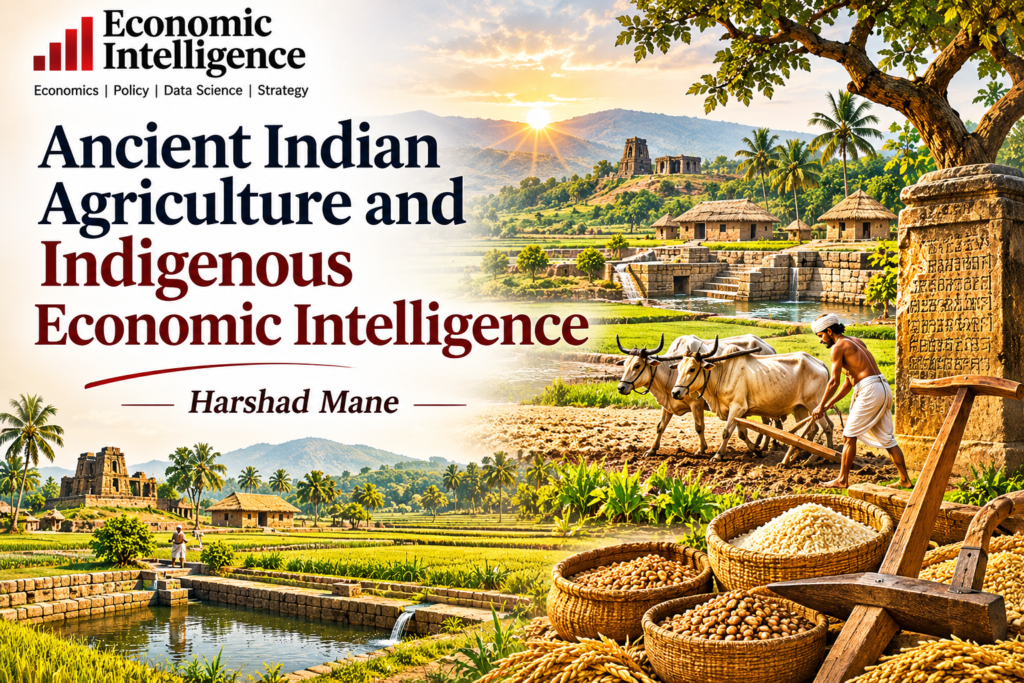
Harshad Mane
Foundational Role of Agriculture:
Agriculture was the backbone of the Indian social structure. As a predominantly rural civilization, farming initiated the transition to organized human society. Over thousands of years, India developed a sophisticated understanding of agronomy and sustainable land use.
State Ownership and Land Grants:
Land was originally state-owned. Rulers distributed lands as tax-free donations (brahmadeya, devadana, etc.) to religious institutions and individuals. These grants had long-term impacts on land management, resource allocation, and regional development, especially in underutilized forested areas which were converted to farmland.
Religious and Political Economy:
Land donations reflected the state’s integration of religious duties and political economy. Kings exercised both faith-based benevolence and pragmatic resource management, indicating surplus capacity and an organized revenue system. Significant parts of North India (Orissa, Bengal, Punjab, etc.) experienced agricultural expansion through land reclamation. Records from travelers like Hiuen Tsang confirm cultivation of diverse crops including rice, wheat, barley, lentils, sugarcane, and cotton across regions. Efficient irrigation systems facilitated multi-cropping and resilience.
Ancient rulers invested in canals, wells, and tanks to support irrigation. Water management was a state responsibility, with examples such as King Lalitaditya diverting river water. Devices like the araghatta (early water-lifting wheel) were common.
Land Classification and Ownership:
Lands were classified into cultivable, barren (khil), and rain-fed or river-fed (matrika vs. dev-matrika). Land rights existed at multiple levels—state, hereditary holders (mulaswami), and cultivators. Even though the king retained overarching ownership, individual rights were well-defined.
Revenue and Taxation:
Revenue systems were sophisticated, including measurement of land, productivity-based taxation, and penalties for under-utilization. Tax was mostly in kind—rice, pottery, livestock, etc.—rather than currency.
The Indian landholding pattern and agrarian class structure were distinct from European feudalism. Though hierarchies existed (mahattar, kutumbin, kutumbik), land rights were not exclusively tied to birth or hereditary aristocracy. Villages had a self-sufficient occupational system (balutedars, artisans, etc.) who provided essential services in exchange for land or part of the produce. Obligatory labor for the state (vishti) was akin to a civic tax, not slavery.
Indigenous Economic Model:
The Indian system blended elements of socialist and capitalist ideologies long before these terms were coined. The state owned productive assets (land), but individuals were rewarded based on effort and productivity. The economic model encouraged efficiency, minimized exploitation, and supported inclusive development.
Regions like Deccan, Tamil Nadu, and Kerala witnessed large-scale agricultural development, often centered around temples and religious institutions. Systems like brahmadeya and devadana were instrumental in expanding cultivation into forests and marginal lands.
Local assemblies (sabhas), temple trusts, and administrative committees (variyam) managed land, irrigation, and taxation. Land grants